As pediatricians, our first priority is the health, safety, and well-being of children. The start of a new school year is a perfect opportunity to make sure our children are ready — not only to learn, but to stay healthy and safe throughout the year. A few simple steps now can make a big difference later.
Start the School Year With a Health Check
As the new school year begins, make sure your child’s vaccinations are up to date, in accordance with immunization guidelines from the American Academy of Pediatrics (AAP) and the California Department of Public Health. In an era when families are exposed to an overwhelming amount of vaccine misinformation, we encourage parents to rely on trusted, evidence-based sources. [Click here for the latest statement from the AAP.]
A back-to-school medical visit is a good time to review any Individualized Education Plans (IEPs), to make sure Illness Action Plans are current — particularly for children with allergies, asthma, diabetes, or other medical conditions — and to discuss sports participation and whether a pre-participation sports examination is appropriate. For children involved in athletics, a focused sports examination can help identify potential concerns, reduce injury risk, and help young athletes enjoy their activities safely.
Getting To & From School Safely
 Transportation safety deserves just as much attention as vaccinations, physicals, and school supplies.
For most children, the school bus is the safest way to travel to and from school. But safety depends on the bus. If the bus is equipped with lap-shoulder belts, children should use them on every trip. California requires school buses manufactured in 2006 and later to be equipped with lap-shoulder restraint systems. It is well documented that properly used lap-shoulder belts provide important protection for young passengers.
Our community has also seen the power of parent advocacy. Support for school bus transportation to University High School from Quail Hill and Los Olivos came about because parents spoke up and brought the issue to City Hall. When families advocate for safer forms of transportation, positive change can follow.
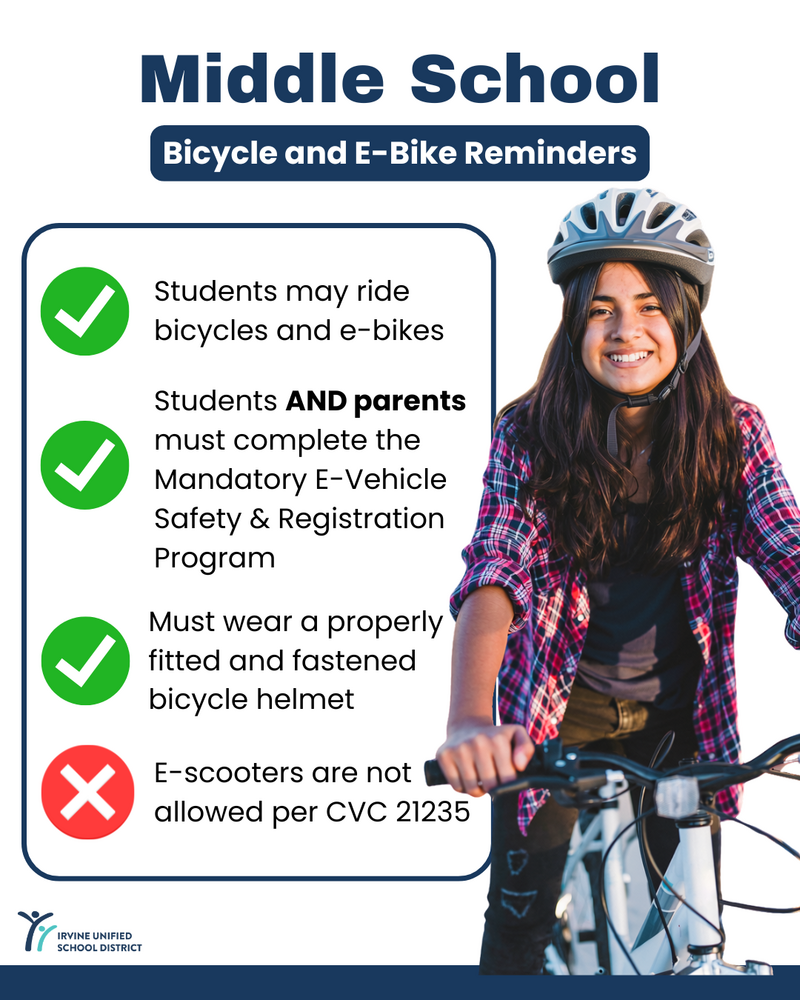
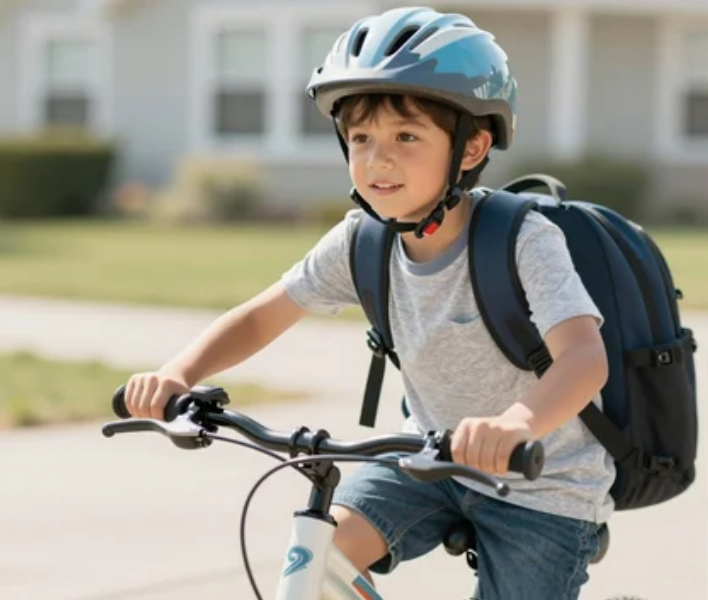 If your child prefers to ride a conventional bicycle to school, the helmet should be part of the routine — every ride, every time. We continue to see children riding with no helmet, a helmet that is not properly secured, or even a helmet hanging from the handlebars rather than being worn. A helmet only works when it is properly fitted, positioned, and fastened. The evidence is compelling: bicycle helmets substantially reduce the risk of head and brain injuries.
In addition to wearing a helmet, make sure your child understands the rules of the road; knows how to ride predictably and watch for cars, pedestrians, and other cyclists; and has practiced the safest route to and from school with an adult.
Electric scooters have become increasingly visible in our neighborhoods and around our schools. It is important for parents to know that California law has specific requirements for operating motorized scooters. Riders must be at least 16 years old and have a valid driver’s license or permit, and helmets are required. That raises an important community question: Why are we seeing electric scooters around Irvine elementary and middle schools when younger children cannot legally operate them? This is an area where families, schools, and our local community can work together to make sure children understand — and follow — the law.
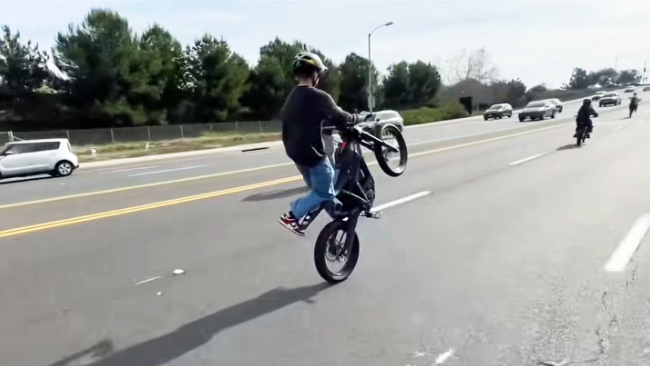
Photo from the Irvine Police Department
The Growing E-Bike Challenge
Now we come to one of the most pressing youth transportation safety issues we are seeing today: electric bikes (e-bikes). E-bikes are rapidly becoming part of everyday life for children and teens in Irvine and throughout Orange County. They can be convenient, fun, and environmentally friendly — but they are also considerably faster and more powerful than conventional bicycles. E-bikes can reach speeds of up to 30 mph, dramatically increasing the consequences of a crash compared with a conventional bicycle.
This is not simply a question of whether a child knows how to ride a bike. It is a question of speed, judgment, traffic awareness, maturity, and the ability to respond appropriately when something unexpected happens.
The Consumer Product Safety Commission’s age-determination guidance has long emphasized that faster motorized vehicles are not appropriate for younger children. E-bike crashes can result in severe traumatic brain injuries, as well as significant injuries to the face, extremities, chest, and abdomen — similar to those seen in motorcycle crashes. As our local trauma surgeons can attest, a serious brain injury can have lifelong consequences for both you and your child. Parents should carefully consider their child’s age, maturity, skill level, and ability to make safe decisions before allowing them to operate an e-bike.
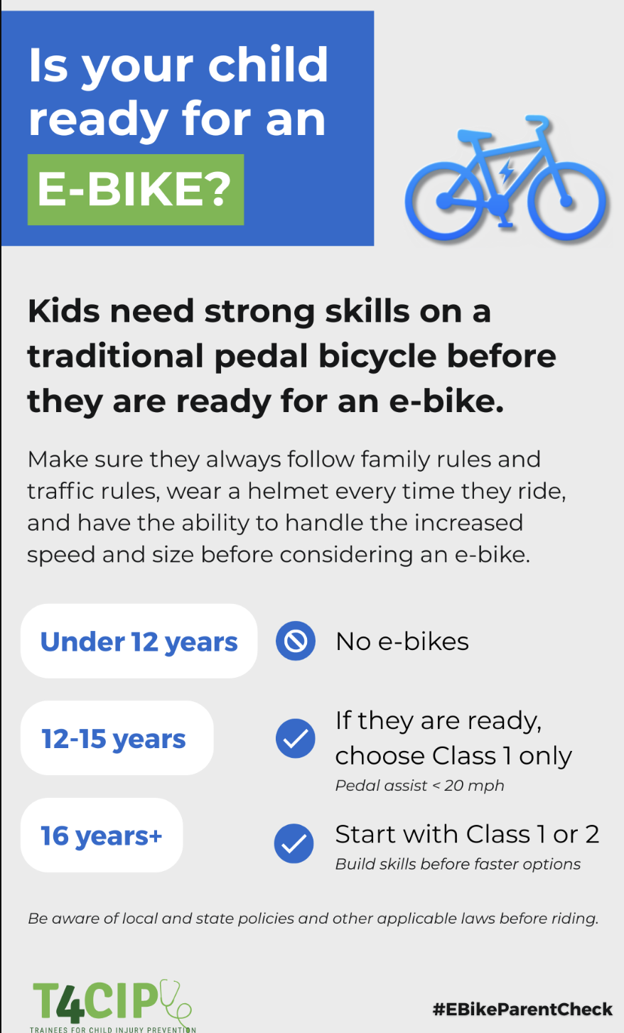 T4CIP (Trainees for Child Injury Prevention) is a remarkable organization that has focused significant attention this year on e-bike safety. As a facilitator, Dr. Agran participated in an e-bike webinar and helped develop educational materials designed to help families make informed decisions about whether a child is ready to ride.
If you are considering an e-bike for your child, don’t make the decision based solely on whether your child can balance on two wheels. Ask yourself if your child is ready for the speed, traffic, responsibility, and judgment that come with riding an e-bike. For children ages 12 and older, the AAP has developed an E-Bike Readiness Checklist to help families think through these issues.
If you decide your child has the necessary skills and situational awareness, the AAP also offers a Family E-Bike Agreement that addresses issues such as distracted riding, carrying passengers, and other important safety expectations.
Whether your child rides a conventional bicycle or an e-bike, a properly fitted and secured helmet is essential. For e-bike riders, however, parents should pay particular attention to the type and quality of helmet being used. Because e-bikes travel at higher speeds, experts recommend considering helmets offering greater protection than a standard bicycle helmet. The AAP emphasizes that helmets significantly reduce the risk of serious head and facial injuries. The Virginia Tech Helmet Lab also provides independent bicycle helmet ratings that parents can consult when choosing a helmet. [Click here to see the ratings.] Remember: NO HELMET, NO RIDE.
Think Beyond the Bike
There is another conversation that families should have before a child begins riding an e-bike: insurance and financial responsibility. Parents should review their homeowners’, renters’, automobile, or other applicable insurance policies to understand what may or may not be covered if their child is injured — or causes injury or property damage to someone else. These conversations may feel uncomfortable, but they are part of responsible e-bike ownership. The tragic death of retired school teacher Ed Ashman while walking near El Toro High School is a sobering reminder that transportation safety affects everyone — riders, pedestrians, drivers, and families.
 Schools and Communities Have a Role, Too
Families should not have to tackle this challenge alone. Irvine Unified School District (IUSD) has partnered with the Irvine Police Department to provide e-bike safety education, including mandatory safety workshops for IUSD students who ride e-bikes to school. Programs like these are important because education, enforcement, infrastructure, and parental involvement all have a role to play.
We want to commend the Irvine Public Safety Department for its efforts to improve the environment for young riders through bike-lane improvements, enforcement, and community education.
Recently, Dr. Agran joined PediaCast host Dr. Mike for an episode focused on e-bike safety and what parents need to know. Click here to listen to the podcast episode.
Keeping Kids Safe Takes All of Us
As pediatricians, we see the consequences when a moment of poor judgment becomes a life-changing injury. We also know that many injuries are preventable. Parents can set expectations. Schools can educate and enforce safety policies. Health professionals can provide evidence-based guidance. Public safety and law enforcement can enforce existing laws. And our entire community can work together to ensure that products marketed to children are accompanied by appropriate safety information and responsible practices.
The goal isn’t to keep our children from being active, independent, or adventurous. The goal is to help them grow into those things safely. As the new school year begins, let’s make safety part of the back-to-school checklist — right alongside the backpack, notebooks, vaccinations, and new shoes. Because getting our children to school is important, and getting them home safely is even more important!
Resources:
T4CIP: E-Bike Safety Day of Action
Healthychildren.org (American Academy of Pediatrics) article by Dr. Phyllis Agran: Are Electric Bikes (E-Bikes) Safe for Kids?
Rady Children’s Hospital (San Diego) Online E-Bike Safety Training Course: Ride Ready SD/E-Bike Safety
California Highway Patrol: Electric Bicycle Training and Safety
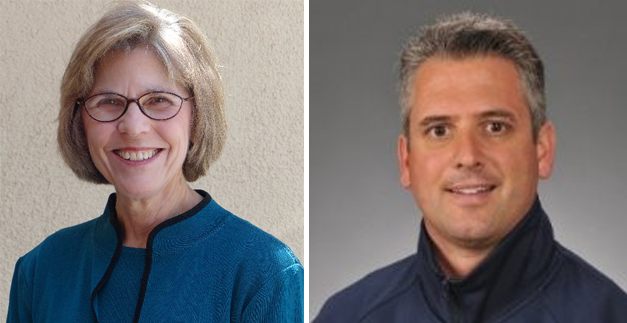
Chris Koutures, MD, FAAP grew up here in Irvine. He is a dual board-certified pediatric and sports medicine specialist who practices at ActiveKidMD in Anaheim Hills. He is a team physician for USA Volleyball (including participating in the 2008 Beijing Olympics); the U.S. Figure Skating Sports Medicine Network; Cal State Fullerton Intercollegiate Athletics; and the Chapman University Dance Department. He offers a comprehensive blend of general pediatric and sports medicine care with an individualized approach to each patient and family.
- Back to School Safety Tips - August 17, 2026
- Body Boarding & Skim Boarding Injuries: How to Stay Safe While Having Fun at the Beach - July 29, 2026
- Water Safety Tips for Kids Heading to Summer Camp - July 2, 2026